Billions of Snow Crab are Missing

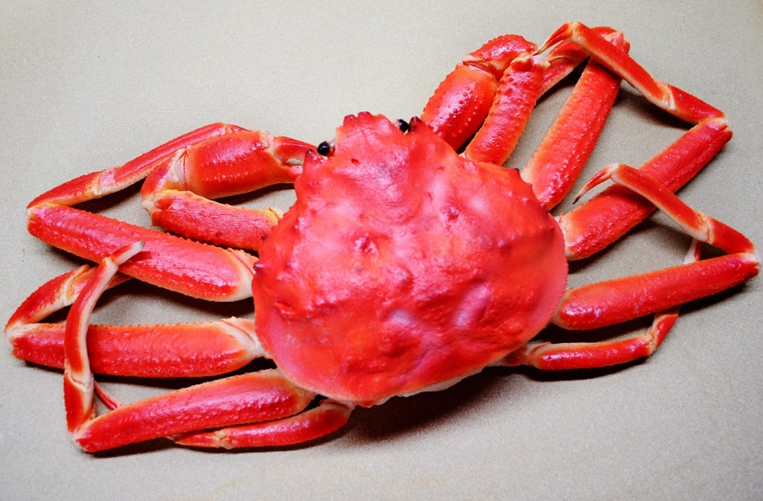
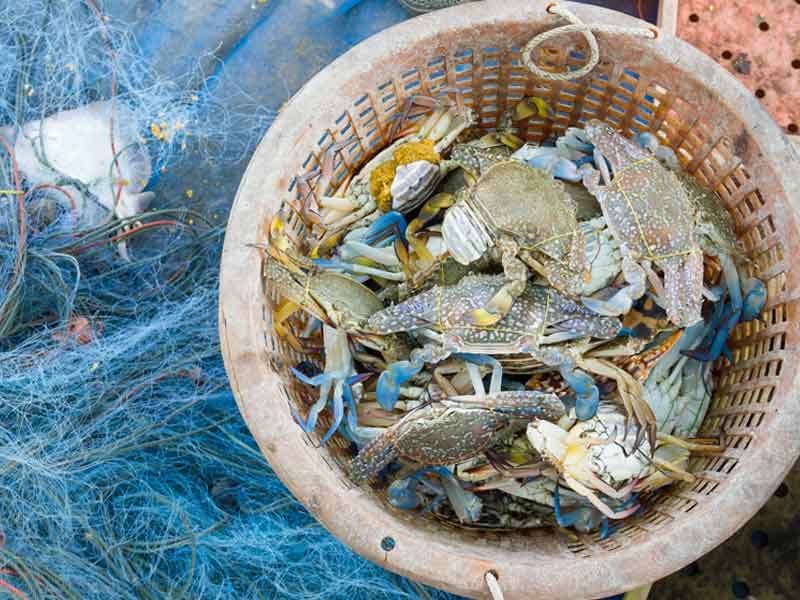
For decades, the population of snow crabs in the Bering Sea off the western coast of Alaska has been unstable. Although an increase in young crabs in 2018 provided optimism for the fishing industry, more than 10 billion Bering Sea snow crabs vanished between 2018 and 2022 due to a population crash coinciding with a marine heat wave. The fishing industry, worth $200 million just last year, suffered significant damage. The cause of the population collapse is being investigated, and researchers believe warmer ocean water may be to blame.

Bycatch, which refers to the unintentional catch of non-target species, has also been a problem for the snow crab fishery. Despite the fishery being closed to crabbers, the bycatch limit for the trawl sector is 3.6 million individual snow crabs this season.

Erin Fedewa, a research fishery biologist with the National Oceanic and Atmospheric Administration, saw the lack of sea ice as a warning sign for the sudden die-off of snow crabs, as sea ice is a crucial part of their life cycle. In winter, sea ice accumulates on the water’s surface, and during the summer, it melts, sending cold, dense water to the ocean floor where it creates a cold pool with temperatures hovering around 35 degrees. The cold pool is a sanctuary for young crabs, and warmer temperatures can lead to starvation and higher disease rates. Scientists are using tanks filled with seawater to replicate conditions on the seafloor and study how different temperatures and pH levels affect the crabs’ development.

Ben Daly, a research coordinator with Alaska’s Department of Fish and Game, is also studying how a shrinking cold pool affects crabs in the Bering Sea. His team is tagging crabs with satellite transponders to track their movement over time and provide more detailed information about the distribution of crabs across the cold pool. In March, a group of state and federal researchers headed out on the Silver Spray to continue studying crab populations outside the lab.

Although it will likely take years for the snow crab population to rebuild, researchers are hopeful that insights gained from this study may help understand how other marine species will cope with climate change.

As the Alaskan snow crab population dwindles, other crab species within the same genus are available to fill the gap.  The Chionoecetes angulatus snow crab, harvested in Japan, and Chionoecetes japonicus, harvested in Korea, are available as economically viable substitutes for the Chionoecetes opilio specie found in the Bering Sea. These alternative sister species assure continuity of supply at a savings for all culinary creations.

This article was produced in collaboration with NOVA, with significant funding from the Corporation for Public Broadcasting.   The original article pre-edited is available at SeafoodNews.com.


State Openings and Labor Shortages Impact Distribution Industry

If you were wondering why common carrier deliveries were being delayed a few business days recently, here are some likely reasons.

Our suggestion since this will likely last for at least a few weeks is to plan ahead and order a week prior.

Here are some likely reasons:

· Common Carriers are inundated with mass loads due to the country opening back up
· Produce is abundant because of the good crops this year and more people home longer
· Lack of qualified drivers due to retirement, ELD’s and pay scale
· Receivers are overwhelmed giving appointments 2-3 weeks out
· Trucker Hubs are at capacity
· Worst hit region so far appears to be North of North Carolina and West of Ohio
· Trucks are filling up faster. Loads are bigger now because of the state openings
· Lack of dock workers for receiving. Not only at the carrier hubs but for delivery docks
· Freight rates are continuing to rise because of the demand for drivers and the longer wait times at each stop due to reduced receiving staff.

If you would like more information or to find out how we can get you out of our docks faster, click here and drop us a line!

Indonesia Is Rising While China Awaits Opening Of 2020 Season

The Indonesian (dry) off-season started recently. This is the time of year when raw material prices go up since the landings are less. The off-season typically lasts until late Q4 but is expected to last until early Q1 2021.

This year, despite COVID-19, it appears that the upward price trend will continue. In the last 2 weeks, overseas costs have risen dramatically. In part, fueled by increased U.S. demand (most likely caused by the depletion of April/May (COVID-19) inventory) and in preparation for the coming holiday season.

The Chinese season, on the other hand, will not begin until August 15, 2020.

The first containers from the new season will begin to arrive in late September/early October. It is quite possible that Red Swimming demand will increase as the blue swimming crab price gap increases.

However, crystal ball predictions are more difficult due to the potential continued tariffs on China and the impact of COVID-19 on the Food Service channel.

Please contact our sales specialist for more information or email us now!

Deepsea Crab Meat

Supreme Crab & Seafood is proud to annouce our newest item, a Deepsea caught crab.  This specie, Paralomis Granulosa, is a Chilean wild-caught crab that we hand-pick in Indonesia.  We are the only one, to our knowledge, that is marketing this product in refrigerated form.

The crab is very chunky, has a great color and appearance and has a sweet, crab flavor.  The Swimming Crab market is rising so our Deepsea Crab is a great option since the price volatility is more stable.   Don’t take our word for it, click the link below to see what others are saying:

Supreme rolls out Chilean snow crab in advance of Boston expo


Historically High Swimming Crab Meat Prices Are Here To Stay?

Blue Swimming Crab Meat Prices are already at a historical high and China is rising now too!

It’s been a few weeks since production started in Indonesia following their holiday (Ramadan and Lebaran). The blue swimming crab landings increased from 5-10% in July. This puts the plants back on track for their prior figures. In other words, the landings right now are not much different from early June. This is putting further price pressures on the mini (cooking) plants since the demand remains strong. The fisherman can choose more easily who to sell too right now. This type of market condition combined with inventories in the US being relatively low compared to the year prior is keeping pricing high. Few are willing to predict when this will end since it isn’t really clear. The one thing that is for certain, we will continue to have high prices through the remainder of the year with little to no softening occurring before October.

Red Swimming Crab Meat is rising faster than the blue swimming crab right now. Correct, that is not a typo! The price movement on red swimming is occurring from four key areas; reduced US inventories, the historical high gap between the blue and red swimming crab prices, the main fishery has been under moratorium, and many customers are trading down to this economical choice. These factors are putting upward pressure on the pricing of red swimming crab meat. The Chinese season starts this month with early arrivals landing here in late September. The new season’s opening raw material costs will not be known for a couple of weeks so stay tuned.

In Summary, price will remain high for all species for the remainder of the year. Many other non-swimming crab species are high and in short supply so there is still enough consumer demand to support the high prices. Will demand continue if the blue swimming crab prices rise much more is the question. However, Fresh Venezuelan packers will be on conservation starting August 15 until October 15 so we expect an increase in blue (and red swimming crab meat) demand.

If you would like more information, please email customerservice@supremecrab.com or comment below.

Prices could exceed 2014 Levels

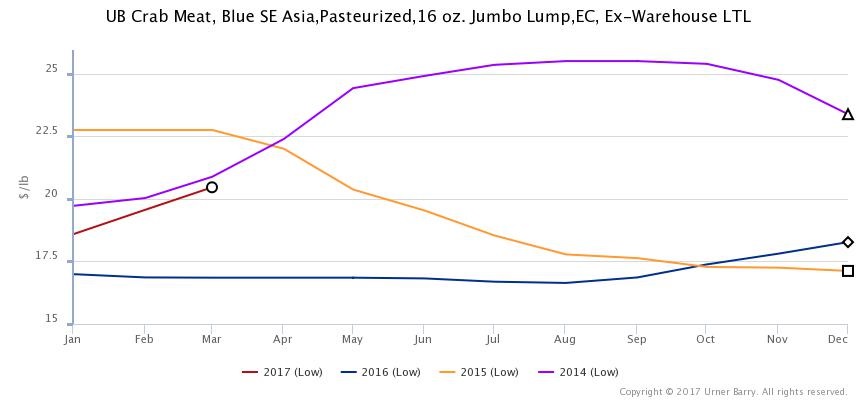
Blue Swimming crab meat prices continue to rise overseas. Typically the landings would have improved by this time of the year but not as of yet. Product landing on next week’s containers will be 5-13% lower (depending upon the size) than product landing in 30 days. Further, the blue swimming crab prices are expected to rise next month as well. This will likely translate to continued high prices leading into the summer. As the chart below from Urner Barry shows, on its current trajectory, Jumbo lump from Indonesia could reach July’s 2014 high of $25.85 per lb. by June.

Raw Material Landings Improving?

Blue Swimming Crab Meat Market Conditions


Has the beginning of the peak season started for Blue Swimming crab meat in Indonesia?  Signs are positive that the commencement of the peak season is likely to begin soon.  The landings haven’t improved a lot but there is more crab…although the crabs are small.  Historically, the landings will become more plentiful once the smaller crabs appear.  However, the main improvement for us is our new operation.  It is our 7th plant and is located in a more remote area than others.  That operation is starting to see more smaller crabs too.

This will impact the picked yields of the crab meaning that the amount of Colossal, Jumbo lump and Super Lump picked will be less than normal and the amount of the other smaller grades will have more pounds available than normal .

Raw material costs have not started going down yet but we anticipate it to stop rising as it has and to level off later this month  or once the peak season is fully underway.    Please contact your product specialist or email us with questions to customerservice@supremecrab.com.


Red Swimming Crab Meat Market Conditions


The Chinese market is sloppy right now due to many importers still selling off last season’s inventory.  Please be careful with the low enticements without asking for the “production date”.  Not the “best by date”!

We expect this market to rise in Q1 2017.


P.S.  This is our last Market Update for 2016.  Thank you for all that follow and have a wonderful holiday!

Industry market update
november 1

As reported last month and now confirmed to be an unfortunate reality, blue swimming supply overseas is depressed and the landings have only worsened through October.  We are now of the opinion that it is possible that the overseas landings will not improve sufficiently until late December or in January.  It would be likely that raw material costs remain steady through January with little reduction.  February or March would become the projected months for raw material cost reductions thereby leaving the US market to the potential of seeing no significant US price declines until Q2, 2017.  This is currently our best guess but as the industry learned 3 times now in the last 8 years, no one can predict the severity of these situations with absolute certainty.  We did open up our 7th plant in October but the landings in this remote part of Indonesia is not yielding significant volume yet.